
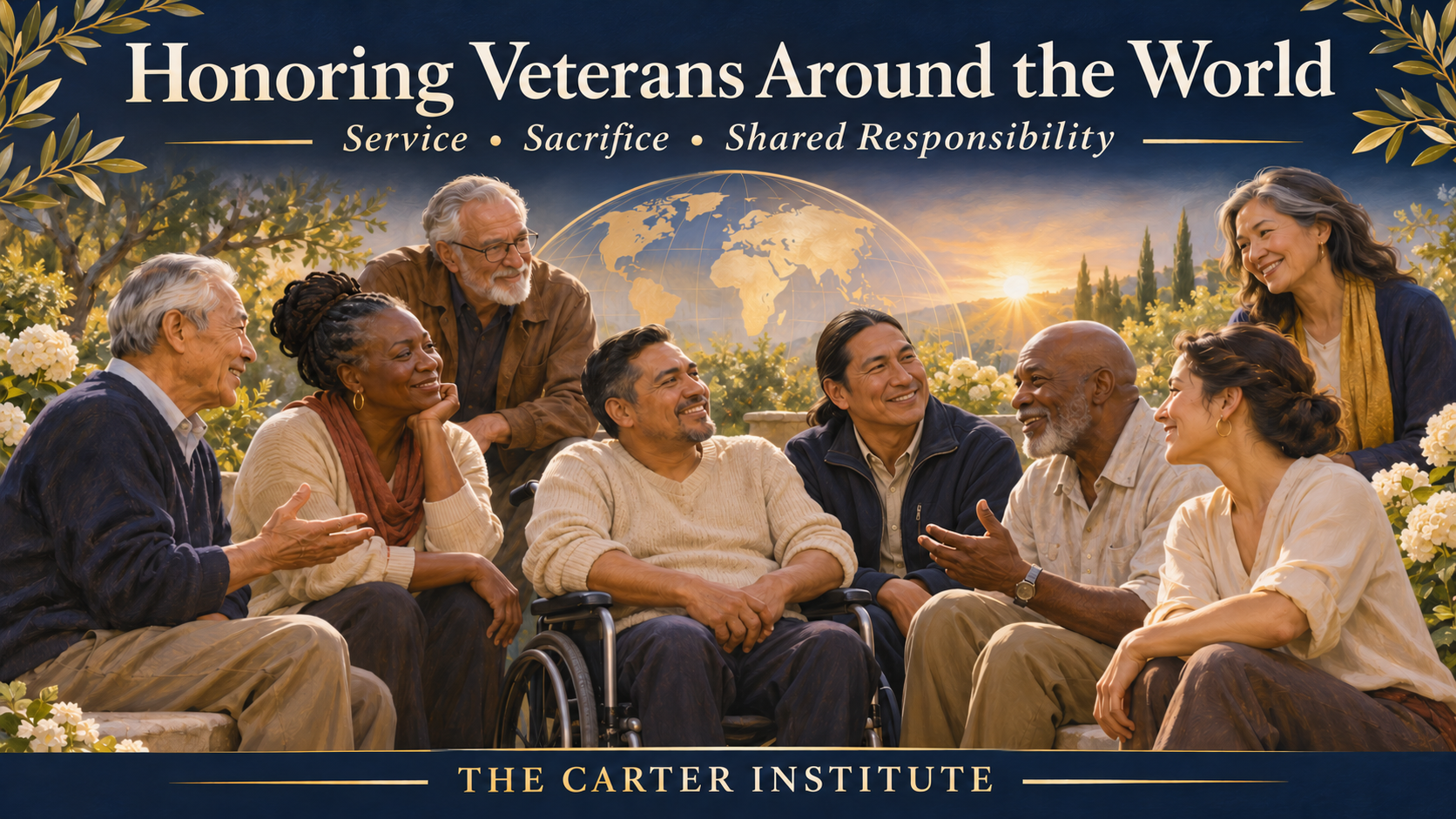
Behind every uniform is a person: a daughter or son, a parent, a spouse, a partner, a friend, a neighbor. Behind every period of service are experiences that can shape a lifetime.
This Veterans Day, the Carter Institute offers gratitude to those who have served in the United States Armed Forces and extends a spirit of respect to veterans around the world. Across borders, languages, and generations, their lives invite us to reflect on service, responsibility, and the lasting value of peace.
Honoring veterans begins with recognition. It grows through listening, learning, and making sure our communities offer meaningful opportunities to belong.
One Date, Different Traditions of Remembrance
In the United States, Veterans Day is observed on November 11 to honor military veterans. Its history reaches back to the armistice that ended the fighting in World War I; in 1954, the American observance became Veterans Day, honoring veterans of all wars. U.S. Department of Veterans Affairs
November 11 also carries significance beyond the United States, although countries do not all observe it in the same way. Canada marks Remembrance Day, while Australia’s Remembrance Day includes a minute of silence at 11 a.m. to remember those who died or suffered in wars and armed conflicts. These traditions have their own histories and purposes, and should be understood on their own terms. Veterans Affairs Canada · Australian War Memorial
For the Carter Institute, this occasion is also an invitation to learn about veterans in countries whose stories may be less familiar to us. Respectful global remembrance makes room for different histories while keeping individual lives at the center.
See the Person Behind the Service
There is no single veteran experience. Service may involve deployment or work close to home; it may include technical, medical, logistical, administrative, or operational responsibilities. What a person carries forward from those years is deeply individual.
Some veterans speak proudly and openly about their service. Others prefer privacy. Some remember lasting friendships, meaningful work, and skills they continue to use. Others may carry grief, injury, or difficult memories alongside those experiences. No one should have to share painful details to receive respect.
An inclusive tribute recognizes women and men, veterans with disabilities, people from different cultural backgrounds, and those whose contributions have received too little attention. It also leaves room for veterans to describe their lives in their own words, rather than asking them to fit a familiar image of heroism or hardship.
Recognize Families and Those Who Stand Beside Them
Military service can also shape family life. Partners, children, parents, friends, and caregivers may share in long separations, uncertainty, moves, and the work of rebuilding daily routines.
Our gratitude should make room for these relationships. A welcoming classroom, an understanding workplace, an accessible community event, or a practical offer of help can communicate care in ways that a ceremonial thank-you alone cannot.
Turn Gratitude Into Everyday Action
A day of recognition can become a starting point for lasting commitment. Consider one action that fits your community:
- Listen with permission. Invite a veteran to share what they would like others to understand. Let them choose the subject, and accept when they would rather not discuss their service.
- Support a local veterans organization. Ask what help is currently useful before donating goods, time, or money. Review the organization’s work and accountability before contributing.
- Create opportunities for belonging. Include veterans and military families in community projects, learning programs, and social activities throughout the year.
- Value experience fairly. Employers and educators can consider how skills developed during service relate to civilian work and study, while listening to each person’s goals.
- Make participation accessible. Consider mobility access, seating, transportation, and a quieter space when planning an event.
- Preserve a story responsibly. With clear consent, record an interview or help organize photographs and letters. Agree on what may be shared, with whom, and what should remain private.
The most useful gesture often begins with a simple question: “What would be helpful to you?”
Teach Children About Service With Care
For children, a Veterans Day lesson can begin with familiar ideas: helping others, keeping commitments, working as a team, and caring for a community. Explain that veterans are people who have served in the military, and that their experiences differ.
An age-appropriate activity might invite students to create thank-you cards through a willing community partner, explore a veteran’s publicly shared story, or compare remembrance traditions in two countries. Older learners can discuss how societies support people after service and how historical accounts change when more voices are included.
Avoid asking children to reenact combat or pressuring a guest to describe frightening experiences. Instead, offer questions such as: “What did you learn about teamwork?” or “What would you like young people to know about your life?”
Education can help gratitude become informed and personal. It can also remind learners that honoring service and working toward a more peaceful future belong together.
Our Tribute
To veterans in our communities and around the world: we honor your service, recognize the individuality of your experiences, and value the lives you continue to build beyond the uniform.
To families, caregivers, and loved ones: we recognize the care and commitment you have shared.
At the Carter Institute, we believe this day carries a responsibility—to listen thoughtfully, learn honestly, and help build communities where dignity and opportunity endure. Today, we pause with gratitude. In the days going forward, may our actions give that gratitude meaning.
We honor your service. We respect your stories. We carry forward a commitment to care and peace.
Organizations Assisting Veterans
You will find below a list of organizations that assist veterans and their families. As we are well aware that there are hundreds if not thousands of additional organizations around the country and the world assisting veterans, this list is simply a starting point for you to learn about programs and assistance available to veterans, and how you might provide your assistance to veterans and their families, either locally or nationally, going forward.
| Organization or program | How you can help |
|---|---|
| DAV — Volunteer Opportunities | Explore local opportunities to assist veterans through hospital volunteering, errands, and community projects. DAV |
| Fisher House Foundation | Support families staying near loved ones receiving medical treatment. Contact a local Fisher House about preparing meals, organizing requested supplies, or helping around the house. Fisher House Foundation |
| Habitat for Humanity — Repair Corps | Learn about critical home repairs for eligible veterans and ask a participating local Habitat affiliate about volunteering or supporting its work. Habitat for Humanity |
| Hire Heroes USA | Share professional knowledge with transitioning service members, veterans, and military spouses through career conversations and employment preparation. Hire Heroes USA |
| Soldiers’ Angels | Explore virtual and in-person volunteer roles supporting veterans, military families, and service members. Opportunities include veteran support activities and volunteer-led assistance for caregivers. Soldiers’ Angels |
| TAPS — Tragedy Assistance Program for Survivors | Help support families grieving a military loved one through events and other volunteer activities. Specialized mentoring roles have additional eligibility and training requirements. taps.org |
| VA Center for Development and Civic Engagement | Connect with volunteer and donation opportunities at VA facilities, supporting veteran patients and services in your community. volunteer.va.gov |
| Veterans History Project — Library of Congress | With a veteran’s consent, record an oral history or contribute eligible original photographs and correspondence. Students ages 15 and older can participate, making this a meaningful educational project. |
Leave a Reply