
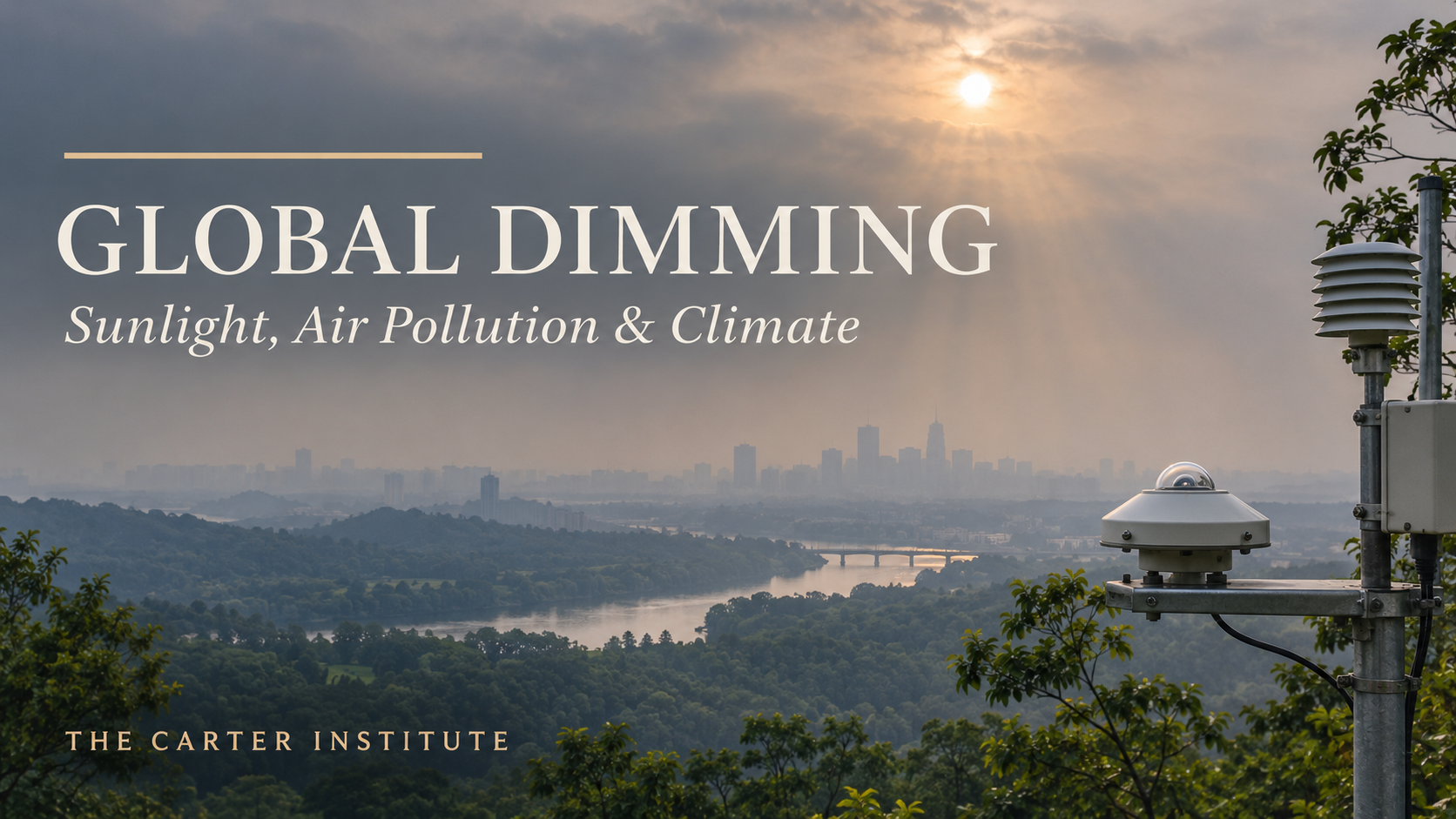
Why Sunlight, Air Pollution, and Climate Policy Belong in the Same Conversation
The Carter Institute | Environment, Research, and Global Wellness
Sunlight powers the water cycle, supports food production, and provides energy for ecosystems and communities. Yet the amount reaching Earth’s surface can change even when the Sun itself is not the cause. Airborne particles and changes in clouds can reduce that incoming light—a phenomenon known as global dimming.
Understanding dimming helps explain why air pollution and climate change require coordinated responses. The same emissions can affect atmospheric temperatures, rainfall, and the air people breathe through different physical processes.
What is global dimming?
Global dimming describes a decline in solar radiation reaching the ground. Scientists documented widespread dimming between the 1950s and 1980s, followed by a partial recovery, or brightening, at many observation sites. These changes have varied across regions and decades; they are not a uniform worldwide trend. [1]
Tiny airborne particles called aerosols play a major role. Sulfate particles scatter sunlight, sending some back toward space. Black carbon, a strongly absorbing component of soot, intercepts sunlight and heats the atmosphere while reducing the light below. Aerosols can also change clouds: more numerous, smaller droplets can make clouds more reflective when other conditions are comparable. [2]
Consequently, less sunlight at the surface does not necessarily mean every pollutant cools the planet. Particle composition and interactions with clouds matter.
Why global dimming matters
It complicates the climate picture
Human-produced aerosols have had a net cooling influence, offsetting some greenhouse-gas warming. Reducing reflective aerosol pollution can remove part of that cooling influence. This does not make pollution beneficial overall; it makes rapid reductions in greenhouse gases essential alongside air-quality improvements. [1]
It can alter rainfall and water security
Aerosols affect the energy available for evaporation and can alter atmospheric circulation. Research by Bollasina and colleagues linked human-produced aerosols to the weakening of South Asian summer monsoon rainfall during the second half of the twentieth century. Such findings matter for communities whose farms and water supplies depend on seasonal rain. They do not establish that aerosols cause every drought or rainfall change. [3]
It changes conditions for plants and ecosystems
Plants respond to the amount and distribution of light, as well as temperature and water. Diffuse light can reach deeper into dense plant canopies, sometimes improving photosynthesis even when direct sunlight declines. A 2009 modeling study examined how these changes influenced the global land carbon sink. Ecological outcomes therefore require more careful analysis than assuming that dimming always lowers plant productivity. [4]
It connects environmental change with public health
Many combustion sources release both climate-relevant emissions and harmful air pollutants. The health consequences arise from pollution exposure, rather than dimming itself. WHO identifies cleaner energy, transport, industry, and waste systems as important ways to reduce that exposure. [5]
Solutions: Address the emissions and the underlying warming
Coordinate air-quality and climate policies. Evaluate carbon dioxide, methane, and particulate pollution together. Pollution controls remain necessary, while replacing fossil-fuel combustion can address several emissions at their source. Methane reductions support climate protection; methane is not itself a dimming aerosol. [5,6]
Prioritize black carbon reductions. Cleaner household energy, improved diesel emissions controls, and alternatives to open waste and crop-residue burning can reduce soot. Because black carbon absorbs sunlight, reducing it offers climate benefits alongside cleaner air. [6,7]
Expand accessible alternatives. Affordable clean cooking, dependable public transportation, and efficient buildings make emissions reductions practical. Programs should account for the costs faced by households and communities with limited resources. [5,6]
Maintain atmospheric monitoring. Long-term radiation, cloud, and aerosol observations help researchers distinguish regional changes from short-term variability. Publicly accessible records also give educators and communities a stronger basis for interpreting environmental claims. [1]
Plan for changing water and agricultural conditions. The monsoon evidence supports including aerosol influences in regional climate research. A practical implication is to bring atmospheric scientists, water managers, and agricultural planners into the same discussion, while evaluating local adaptation options with local evidence. [3]
An opportunity for public education
Global dimming offers an accessible lesson in connected systems. A classroom or community workshop could ask: What happens to sunlight after it enters the atmosphere? How do particles differ? Why can cleaner air reveal warming that was already being masked?
At The Carter Institute, these questions connect research with everyday understanding. Informed environmental decisions begin with recognizing that clean air, a stable climate, and resilient communities are shared goals—and that achieving them requires action across sectors and borders.
Sources and further reading
- IPCC (2021). Chapter 7: The Earth’s Energy Budget, Climate Feedbacks, and Climate Sensitivity, particularly Sections 7.2.2.3 and 7.3.3.
- NASA Earth Observatory. Aerosols: Tiny Particles, Big Impact.
- Bollasina, M. A., Ming, Y., & Ramaswamy, V. (2011). Anthropogenic aerosols and the weakening of the South Asian summer monsoon. Science, 334, 502–505. NOAA research explanation.
- Mercado, L. M., et al. (2009). Impact of changes in diffuse radiation on the global land carbon sink. Nature, 458, 1014–1017.
- WHO. Ambient (outdoor) air pollution.
- WHO. Air pollution: Reducing short-lived climate pollutants.
- Climate & Clean Air Coalition. Black carbon: Sources, impacts, and solutions.
Leave a Reply